

The majority of the people in Bangalore think of investments in two ways — one, investing in real estate and watching it sit; two, investing in stock market and rising cortisol. There is a third that has been growing quietly just outside the city limits but has a tax benefit not matched by either of those two options.
The dream of tax-free income from the managed agricultural land in Bangalore is not a marketing ploy or an out-of-the-box proposition. It is supported by a specific clause in the Indian Income Tax Act, is made possible by a ground-breaking land reform in Karnataka in 2020, and is driven by a growing and well-trained farm management industry, especially around Bengaluru, in the past few years.
This guide outlines the workings, the facts, what you can expect and who can purchase as well as what to check before you sign anything.
The Tax Law at the Centre of This: Section 10(1)
First, the foundation and then the rest.
The income from agriculture is completely exempt from central income tax as per section 10(1) of the Income Tax Act, 1961. Income that is agricultural income as per the Indian law is not subject to tax levy by the Central Government. This is not a deduction or a rebate, it is a straight deductions exemption. They will not be added to your taxable income.
The meaning of what counts is defined under Section 2(1A) of the same Act. The agricultural income is the sum of revenues or rents from land used in agriculture in India, income from the cultivation, sowing, tilling and harvesting of the land, income from basic processing of agricultural produce that occurs on the farm such as grading, drying, cleaning, or sale of agricultural produce grown on the land, and income from farm buildings used in agricultural activities.
A broad interpretation. It’s the reason why a Bangalore IT worker can earn income from a mango orchard outside the city, which is taken care of by professionals on his behalf without the income tax department getting a dime of his income.
There is one thing to know straight. When your agricultural income is more than ₹5,000 and non-agricultural income (salary, business etc.) is above the basic exemption limit, the “partial integration” approach is used to determine the tax slab. Your agri income is added temporarily to ascertain which slab you fall in, but again being deducted before the final tax is calculated. The income from agriculture remains untouched. The rate is applied to your other income, what changes. It is no trap, it is a prevention as for high earners, using farmland as a slab-reduction tool.
The exemption is genuine, recognized and valid. It simply needs to be your real income that is derived from agricultural pursuits — not events, rentals, branded food processing off the land.
What is Managed Farmland, Anyway?
It’s a basic idea. You are the owner of farmland with your name. All work, from soil preparation, irrigation, planting, crop cycles and pest control to harvesting and sales of produce are managed by a professional management company. You never have to check the weather or hire seasonal labourers and you get a part of the income.
It’s like you have an apartment, and you hire a property manager — except you have a farm that produces and you get a tax break from that that you don’t from renting an apartment.
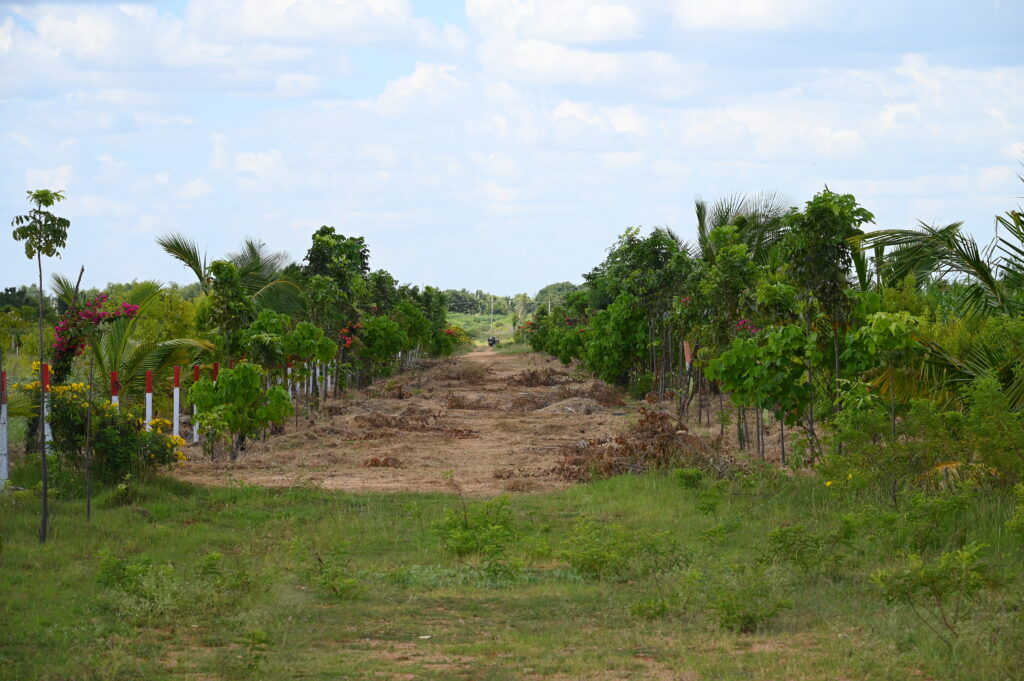
Near Bangalore most of the managed farmland project follows intercropping scheme. When a long-gestation tree crop such as mango, sandalwood, and teak is planted as the main investment. In the early years vegetables, herbs, aromatic plants are planted between trees, as they grow quickly. This will provide the investors with cash flow before the orchard is actually in production.
They either receive a fixed amount of money per year (around ₹25,000 to ₹35,000 per acre) or provide a portion of the profits of crop sales. You own the land! Records of the farm, crop cycles and yield documentation are kept with the operator — and if the tax authority should ever ask, these records are what will confirm the agriculture nature of your income.
Who is the One Who Can Buy a Farm Land Around Bangalore These Days?
The response to this question used to be difficult and for the most part demoralizing for urban investors until 2020.
The Karnataka Land Reforms Act, 1961 had Section 79A and 79B which prohibited the purchase of agricultural land by non-agriculturists in the state. Whether to buy land or not, or the capacity to invest, depended exclusively on the income of the person, and as per the regulations, if a person has any income of more than ₹25 lakhs generated from non-agricultural activity, it meant that he had no right to buy land in Karnataka.
That changed on July 13, 2020. The Karnataka government enacted the Karnataka Land Reforms (Amendment) Ordinance, 2020 — Karnataka Ordinance No. 13 of 2020 — that completely removed the provisions of Sections 79A, 79B and 79C. In addition, the bar on the sale of agricultural land to non-agriculturists under Section 80 was removed. In today’s world, any citizen of India can buy agricultural land in Karnataka without any hassles, irrespective of their agriculture background, occupation or income status.
Agricultural land ceiling has also been lifted. The number of agricultural land units a family can now possess has increased to 20 units which was earlier 10 units. One unit is equal to one acre on A-Class land.
There is one point to note here; the Karnataka government has yet to remove this amendment from the act even after political talks of reinstating the previous restrictions in 2024, as of May 2026. The repeal stands. However, any prospective purchaser of farmland today should seek legal advice as the policy on land reform is not always replicated in the state of Karnataka.
There are different restrictions for the NRIs. Normally, NRIs are not allowed to directly acquire agricultural land in India as per FEMA regulations and RBI guidelines. NRI investors are generally required to invest through Indian resident citizens of their families, or via other approved arrangements with a lawyer.
What Returns Look Like: Grounded Numbers
Managed farm land near Bangalore is not that exciting to a day trader. It’s an asset with a long time-horizon and low volatility. However, when you add the tax exemption into the equation with the land appreciation, the numbers are indeed interesting based on the available data.
This is what a one acre mango orchard would look like under the vegetable intercropping scheme as it passes along the Kanakapura corridor over 10 years. Vegetable intercrops yield about ₹ 40,000 per year in years 1 and 2, during which the mango trees are growing. After 3-5 years, when the trees are mature, farm income is around ₹80,000 per year gross, and management fees are around ₹30,000, resulting in a net income of ₹50,000 per year. After year six, a mature orchard with intercrops can produce a gross income of ₹1.2 lakh per year, and a net income of about ₹90,000 per year after factoring in fees.
Appreciation of land is another added value. Over the past decade, the appreciation rate of the farmland along the Kanakapura road corridor is around 7-12% per year, attributed to the development of infrastructure and expansion of the city boundary in Bangalore. The entry fees of managed farmland projects in Bangalore currently begin at half an acre at ₹25–35 lakhs and a full acre at ₹40–60 lakhs, depending on geography and infrastructure.
In comparison, the traditional Bangalore real estate ‘apartments’ market gives 3-4% rental returns and rental income is subject to complete tax. The farmland income — if it’s real farm production — is not.
The List of Locations That Matter Near Bangalore
Not all the belts around Bangalore have the same investment logic. There are different price, appreciation potential, water and connectivity ratios in each corridor.
Kanakapura Road (South of Bangalore) is an area with deep agricultural history, well endowed with water table, and good infrastructure development. It is favoured by mango and coffee farms and has been consistent in its land appreciation.
Larger plots are available at lower entry level, in Ramanagara and Channapatna (approx. 50 km from Bangalore on the Mysore highway).
Devanahalli and North Bangalore are fast appreciating because of the presence of the international airport as well as aerospace development — prices are higher but there is great appreciation potential.
Orchard projects with reasonable orchard prices and connectivity is found in Hosur Road and Thalli (Tamil Nadu).
There are varying characteristics of soils, water availability and legalities across each zone. When you’re considering purchasing a movie, you don’t have the choice of visiting first.
Before Signing Anything, Make Sure You Verify the Following Tax-Free Income from Managed Farmland in Bangalore
Farmland due diligence is not the same as purchasing a flat with a bank loan, which requires some basic checks. This must be done by yourself or a trusted legal representative.
The first step is to begin with the RTC (Record of Rights, Tenancy and Crops) which is the main land records in Karnataka. It provides you with an understanding of the type of land, the current owner and any encumbrances.
Check the title deed and title history for 30 years or more.
Ensure that no conversion order has been issued that would alter the land’s classification to non-agricultural and thus impact on the tax exemption and the legal use of the land.
Inquire about the availability of water, borewell depth, yield and if the farm has working irrigation system.
Inspect management company records of crop yields, accounts and records. Such documents are what will constitute the real “agricultural” income for legal purposes.
Directly ask the operator about what crops are being produced, what are the crop cycle records, how is the revenue calculated and distributed and what are any non-agricultural income sources, such as agri-tourism or events, that are accounted for separately? If these answers are general, they’re something to take action on.
The Honest Risks
Weather, soil health, market prices and crop health are all beyond the control of agriculture.
If an operator of managed farmland guarantees a predetermined monthly return for his or her enterprise, no matter what crops he or she grows, he or she might be promising something that is not even an agricultural income. A fixed return arrangement is more of a financial instrument than an agricultural one and may be taxed as such.
Land reform policy continues to be lively politically in Karnataka. The assumption that the market was liberalised in 2020 is a valid one, but the politicians talking about turning back the liberalisation in 2024 is no joke. It is important for investors not to take it for granted that the present laws are going to remain in effect forever.
Final Word on Tax-Free Income from Managed Farmland in Bangalore
Income from managed farmland in Bangalore, that is neither taxable nor revenue taxable, is a rare sweet spot that comes together quite nicely — a legitimate tax exemption, policy evolution that made urban investors welcome, a burgeoning ecosystem of professionals managing farms, and land that can appreciate in a city that will not rest.
It is not a get rich quick game. It pays patience, good due diligence, and selecting operators who make farming the business line, not something that is merely a cover for other businesses.
If done correctly, it’s an asset that generates income that the tax man can’t claim, increases in value as the land market does and provides you with something you can actually show for.
Please seek professional advice from a Chartered Accountant and a property professional lawyer in the state of Karnataka before investing. The law is good, it’s the execution that gets personal.