
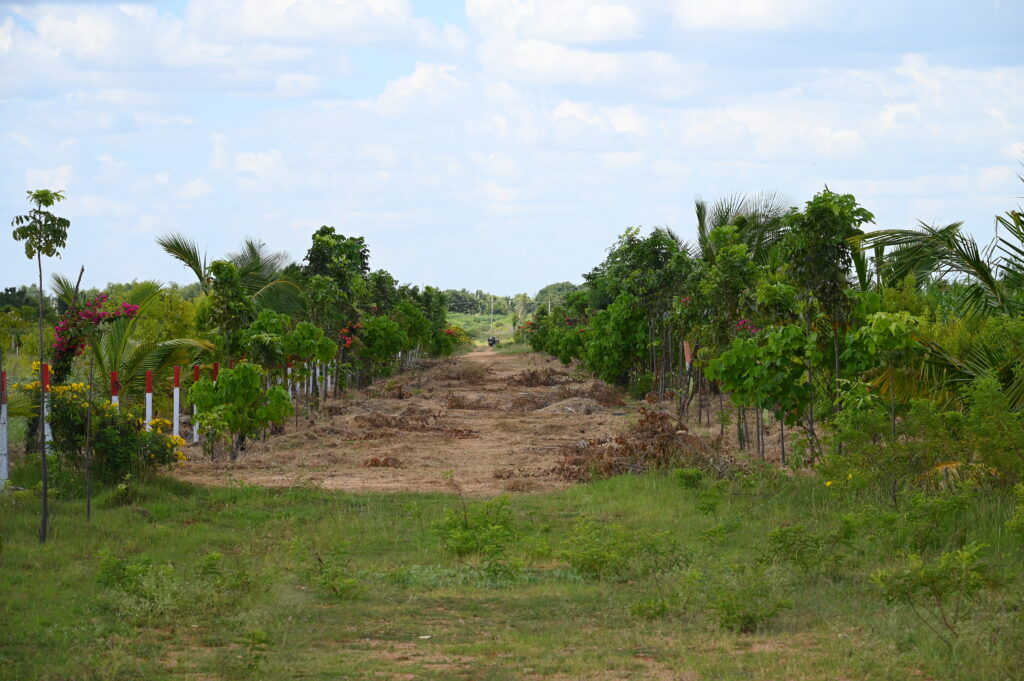

The fantasy almost every Bangalore professional has in their back of their mind is a small plot in the outskirts of the city with a small building, fresh air, some greenery, a cup of tea without the traffic noise. Fantasy is okay. What too many people are looking to do is make it a product purchase instead of a thoughtfully considered investment, but they aren’t doing so with a big enough understanding of what they are buying.
The sale of farmhouse plots in Bangalore is not about merely grappling with land law and construction guidelines, but about navigating the delicate balance between agricultural law and investment logic, as well as between construction rules and lifestyle aspirations.
This guide explains the full story, including the legal definition of a farmhouse plot, what you can do with it, the corridors to consider, the current market price and what documents to check before you finalise an offer.
So, What is a Farmhouse Plots for sale in Banaglore, Legally Speaking?
The use of “farmhouse plot” is not standardized in real estate listings, and this lack of standardization creates real issues.
A farmhouse plot as most people would perceive is agricultural land and agricultural land in India is regulated by a very specific set of rules with regard to what can be built, who can own and how the income generated can be treated.
The majority of times, a farm house plot for sale is farmland away from the city’s main urban centre. This is an agricultural land title if you buy it. There might be a small structure already on the land or maybe you plan to erect one.
However, most brochures will fail to convey this information: Agricultural land in Karnataka is not suitable for constructing a residential house without any hesitation whatsoever, irrespective of the sales agent’s claim.
As per Karnataka rules, a farmhouse which is ancillary to agriculture is allowed on agricultural land. As per the commonly quoted rule, which is verified by the legal practitioners, construction on land under BMRDA is limited to 10% of the total land area as ground coverage. That equates to a maximum footprint for a 10,000 square foot plot of 1,000 square feet.
This structure should be sanctioned by the local Gram Panchayat, the land should be still agricultural in RTC and it should be incidental to farming and not independent residential/commercial use.
If you wish to convert land for anything other than agricultural use or if you are planning to construct a complete residential house on the land, you should get government approval, pay conversion charges and change the land classification as per the Karnataka Land Revenue Act, Section 95.
The new Karnataka Land Revenue (Amendment) Rules, announced by the Karnataka government in December 2025, have relaxed the norms of auto-conversion for farmlands that are part of a master plan in urban development, reports the Deccan Herald. Outside of these urban master plan areas, however, formal conversion is still a separate process that cannot be bypassed.
This is the fact that if you’re buying, you’ll have a far less stressful legal experience if you understand this distinction beforehand.
Who Can Purchase Farmhouse Plot Near Bangalore?
This is a complex question prior to 2020.
On 29th July 2020, the restrictions on non-agriculturist purchase of agricultural land in Karnataka since 1974 have been removed by the Karnataka Land Reforms (Amendment) Ordinance, 2020 (Karnataka Ordinance No. 13 of 2020).
Agricultural land is now open for all the Indian citizens irrespective of their agricultural background or income status.
However, there is a significant proviso to be noted:
In 2024, the Karnataka government announced its plans to revoke the measures that were put in place, in public. There is no legislation in effect that reinstates them, although there is discussion in politics as of mid-2026.
Your best bet for finding out what the current legal landscape is would be to get the help of a qualified property lawyer from the state of Karnataka, who will be able to give you the advice you need in relation to the standing of your property.
NRIs have a different and more stringent process.
NRIs are in general not allowed to directly buy agricultural land in India under FEMA guidelines.
Generally, NRIs looking for farmhouse plots near Bangalore should consider engaging with a resident Indian family member or other legal ways that is accepted by law with the proper legal advice.
The Corridors That Matter: Where to Look
The farmhouse plot market in Bangalore is divided into several distinct corridors, each having its own character, pricing and investment logic.
The selection is dependent on the purpose of the land, whether for weekend retreat or long-term investment, for income generation from farming or for some other reason or a combination of these.
Kanakapura Road & Ramanagara
The premier southern belt is Kanakapura Road and Ramanagara.
The highest quality farmhouse plot investment zone is this one, for the reasons of fertile soil, reliable rainfall, access to the NICE Road corridor and a rich agricultural tradition.
According to Delight Eco Farms land price guide for the year 2025, Bangalore farm belts and eco-estates sell managed farmland projects at an average price of ₹40–70 lakh per acre.
Across the same belt, in pockets where development has not taken place, raw agricultural land is starting from the bottom at ₹25–40 lakh per acre, depending on the availability of water and location.
Devanahalli, Doddaballapur & North Bangalore
Devanahalli, Doddaballapur, North Bangalore have an alternate value proposition.
Infrastructure development has been persistent in this corridor and has been pushed by the Kempegowda International Airport and the Satellite Town Ring Road.
Outsides pricing in Devanahalli and Hoskote for developed-infrastructure areas is in the range of ₹1.5-2.5 cr per acre whereas the farmland is much lower.
Investors who are purchasing this property for appreciation are making a good guess that this infrastructure momentum will continue, but they must have a longer holding period.
Hosur Road & Thalli Belt
The Hosur Road and the Thalli belt, which passes into Tamil Nadu, is a specific mention.
From the beginning, there have never been any restrictions in Tamil Nadu like Sections 79A and 79B in Karnataka, allowing any Indian citizen to buy agricultural land in the State without any hindrance.
This was a very attractive proposition to the Bangalore based IT professionals, particularly the ones working in Electronic City or Bommasandra.
Land cost is relatively low in this area as compared to Kanakapura, suitable climate for mango orchards, horticulture and mixed farming.
Chikkaballapur & Nandi Hills
Buyers seeking a cooler micro-climate and a scenic location will like Chikkaballapur and Nandi Hills.
They’re becoming a favorite place for farm stay and agri-tourism experiences.
Nelamangala & Western Corridor
Investors who can afford a longer appreciation period will find bigger holding areas at lower entry price in Nelamangala and western corridor.
How Much Are Farmhouse Plots Bangalore Worth in 2026?
The farmhouse plot pricing in Bangalore is quite wide with a broad range for a reason, as its location, water access, existing infrastructure, soil quality and plot size does affect the price considerably.
For most managed farmland projects, near Bangalore, where you purchase a plot within a professionally designed development with fences, roads, irrigation, and farm management, the entry price is normally around ₹50 lakh per acre as per Sanjeevani Farms’ Farmland investment guide for 2026 and the acquisition cost of farm plots near Bangalore is ₹50–80 lakh per acre as per HasiruFarms’ Farmland investment guide for 2026.
The maintenance and management charges for professionally managed plots range from ₹25,000 to ₹40,000 per acre per year, including irrigation, labour and cultivation costs.
The price range for farmhouse plots that are sold separately from other properties, and not managed by the government, is wide.
Delight Eco Farms’ area-wise guide indicates that rural agricultural land in Kanakapura and Hosur belt fetches ₹25-45 lakh per acre in pockets; while outskirt areas of the farm near active infrastructure corridors like Devanahalli have higher valuations of ₹1.5 to 2.5 crore per acre in developed micro-locations.
According to the averaged farmland listing data provided by the Farmland Bazaar, the value of the managed plots varies between ₹16.5 lakh for quarter-acre plots in Adavisomapur and ₹1.09 crore for premium plots cultivating sandalwood in established projects.
The premium for a managed project over stand alone land is for the infrastructure provided, legal pre-verification, collective maintenance, and professional cultivation management – all of which would be your responsibility if you didn’t manage the project.
What You Can Build: Construction Rules You Need to Know
This is the part that most potential purchasers overlook, and it’s the most important one after they buy.
In Karnataka, the building of a farmhouse ancillary to agricultural land is allowed.
It is practice at BMRDA that the maximum percentage of ground surface is 10% of the total area of the land, and it has been confirmed by legal experts at Kaanoon.
The 10% footprint allows for around 4,356 sq. ft. of ground coverage for a 1 acre plot (43,560 sq. ft.).
Construction should be done with the consent of the Gram Panchayat.
The land has to be still be in the RTC as agricultural land.
The use must be a real ancillary use to farming.
Without land conversion, it’s not possible to construct a permanent residential house for non-agricultural use.
No commercial hospitality business can be run from agricultural land without the necessary CLU (Change of Land Use) permissions.
Anything larger than the footprint is not allowed to be built without conversion approval.
If the buyer desires a complete residential structure, a property that has already been converted, or a permanent residence, then the only way to go is to buy a converted piece of land or apply for Section 95 conversion, before construction, under the Karnataka Land Revenue Act.
Some peri-urban farmhouse plot buyers have benefited from the Karnataka Land Revenue Amendment Rules of December 2025 that have relaxed the norms of auto-conversion in plots in an urban master plan zone.
If your plot is located outside of those zones, the manual conversion process is used.
To get construction wrong is costly.
Agricultural buildings with illegal structures are subject to demolition orders and penalties.
Design it carefully before you lay the first brick.
Legal Due Diligence: The Papers That Guard Your Investment
There is no RERA equivalent for land used in agriculture.
The only protection is on the document and if you skip any step or careless, it may not be possible to go back.
At least, the documents to be verified are:
- The Title Deed, which has to have an unbroken chain of ownership over the past 30 years.
- The 30-year Encumbrance Certificate from the Sub-Registrar’s office, with no mortgages or court attachments.
- RTC (Record of Rights, Tenancy and Crops) or Pahani, which has to be in the name of the seller exactly as it is in the Title Deed.
- The Mutation Register Extract, which has to show that the ownership of the plot has been transferred in the government revenue records.
Additional Checks
Check the PTCL status, beyond the basics.
Plots allotted to families of Scheduled Caste and Tribe under PTCL Act are subject to transfer restrictions which may need clearance from District Collector for legal transfer.
A reference was also made to the PTCL bar in the 2025 Supreme Court observation, which was related to Karnataka’s land reform timeline.
See if the site is located in an eco-sensitive zone, a storm water drain buffer area, a green belt reservation or a road widening plan – all of which have construction restrictions which are not stated in the title deed but can alter what you are able to build.
In case the plot is inherited land, inquire with the Tahsildar’s office for a legal heir certificate and obtain the written consent of other heirs who are not a party to the sale.
That team is never going to buy 95% of the land they inspect and according to The One Acre Farms, due diligence guide, the defects don’t come up at the listing level.
All this should be done through a completely independent Karnataka registered property lawyer.
Legal documents supplied by the developer are only a starting point—do not rely on them instead of conducting independent research.
The Investment Case: Returns That Look Like This
Near Bangalore, a farmhouse plot provides three benefits:
- Land appreciation
- Crop or rental income
- Lifestyle benefit
Around Bangalore, farm land in active corridors has appreciated by 10-15% p.a. in recent years, as a result of infrastructure development and urban expansion and growing demand for weekend homes with clean air, according to the investment data from HasiruFarms.
Conservative estimates suggest a real appreciation of 6–8% per year — a respectable performance for a tangible asset with no market volatility.
Income from registered land generated as a result of actual farming activity will be exempt from income tax at the central level under Section 10(1) of the Income Tax Act, 1961, provided that the land is registered under the Act.
According to the data from Farmland Bazaar, returns between 10–25% are reported on active farmland projects, which include crop income and appreciation — though returns closer to the high end of the range are on premium organic and sandalwood projects with long timelines where the returns are “back loaded”.
A farm house lot, within 50 – 80 kms of Bangalore is a lifestyle utility which an apartment and a financial instrument can’t provide – a real location to visit.
That has genuine value — and it tends to make the investment hold-period feel shorter than it is.
For the New, a Word of Warning on What to Watch Out For
While farmhouse plot marketing in Bangalore has certainly come a long way, there are still certain challenges that are common.
Plots which are listed as “ready to build” on agriculture land should be asked specifically if Gram Panchayat approval is obtained and what construction is allowed.
If the offer is for a fixed rent on a farmhouse plot, and the legal structure and status of the plot (PTCL) are not clearly specified, then more investigation is warranted.
Any project where the boundary markers have not been physically erected, the RTC is not in the deed to the land, or the mutation is not updated, is a project that will require a legal review prior to any payment.
Final Thoughts on Farmhouse Plots for Sale in Bangalore
The Farmhouse plots for sale in Bangalore are a true investment and lifestyle opportunity in 2025.
Five years later, the legal landscape has become more definite and the professional management system has developed, and the interest in properties beyond the city’s noise has increased.
It is a safe opportunity due to diligence.