
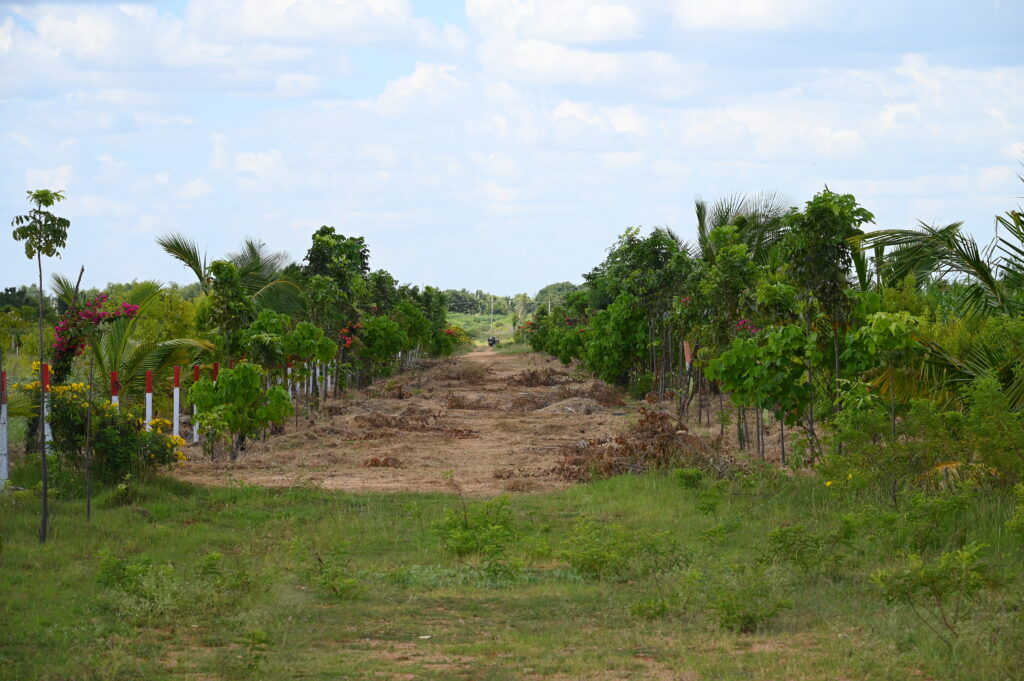

In marketing terms, “managed farmland” is a quick sell and a company will do it for you and you’ll get the profits and still be able to visit the farm and take vacations. It is a multi-step process that involves legal transfers, ongoing contracts with the owner and ongoing co-ordination between the owner and the management company. This guide explains how it works in detail, from its first purchase to years of use.
Note: This information guide pertains to general information on managed farmland arrangements. Each contract and individual terms are unique for each developer and project and it is important to read your actual contract and communicate with a property lawyer prior to signing a contract.
The Basic Model Managed Farmland Near Bangalore
The key to managed farmland is that it is at its heart separating ownership from operation of land:
- The legal title to a particular plot is vested in you (the buyer) typically as part of a larger farmland development.
- The management company is responsible for growing, tending and, frequently, selling produce in return for a fee or a percentage of the profits.
- The developer (the same or a different company to the management company) is typically the one that owns the land originally, subdivided the land, provided infrastructure and sold to individual buyers.
In this way, you can obtain real assets, and income and/or capital value from the assets, without knowing anything about farming, or participating in the daily operations.
Step-by-Step: How It Works From Start to Finish Managed Farmland Near Bangalore
Step 1: Select the Project and Do the Research
It’s the usual custom of buyers to conduct thorough research before buying one of the farmland projects and they generally compare the location, type of crops grown, the price, the developer’s reputation, and how they are managing the fees. These may include visits to the property and the sending of brochures, and discussions with the developer’s sales.
Step 2: Due Diligence
This is the crucial and rushed step. It includes:
- Title search — checking if there is any legal dispute to the ownership of the land underlying the land parcel and the developer’s rights to sell subdivided plots.
- Encumbrance certificate survey — to determine if there are any outstanding loans, claims or disputes on the land.
- Fees payable on the day of the transaction. Eligibility to buy agricultural land will be checked and fees must be paid on the day of purchase.
- Water and soil assessment — Evaluation of the yield of borewell and the trend of groundwater and soil quality of the plot being evaluated.
- Knowing what can be legally built or done on the land based on the zoning (and conversion) status.
Step 3: Plot Selection and Booking
Once a buyer makes a decision, he/she selects one of the plots in the project and then depending on the location of the plot (corner/near water/near road) pays a booking amount to secure the plot.
Step 4: Sale Agreement & Payment
A formal sale agreement is signed, which specifies how much is being sold for, when payment will be received and the terms of the sale. At times, payments are made in tranches, depending on the project progress (e.g., booking payment, registration, infrastructure completion).
Step 5: Registration and Transfer of Title
This is achieved through the sale deed and registration with the local sub-registrar which will form the conveyance of the particular plot to the purchaser. Stamp duty and registration fees will be applicable as per the state where the property is to be registered and the transaction value.
Step 6: Mutation of Land Records
The second important step which is missed is once registered the ownership is recorded in the land records as per the local revenue records (Mutation).
Step 7: Signing the Management Agreement
Along with the land sale, buyers typically sign a management agreement (may be bundled with the land sale or as a separate agreement) with the management company. This agreement covers:
- The crops that will be cultivated and kept on the plot.
- The management fee/revenue sharing arrangement (annual).
- What services are covered (irrigation, security, labour, harvesting, selling of produce).
- The length of contract and conditions of renewal.
- Conditions which are used to determine whether exit or termination of the loop.
Step 8: Land Development and Planting
Management company to prepare the plot, including preparation, clearing, soil preparation, irrigation, planting of crops – fruit trees, plantation crops, vegetables etc.
Step 9: Continued Cultivation and Maintenance
The farm management company takes care of the day-to-day running of the farm, such as watering, fertilising, pest control, pruning etc and typically the owners will be kept up to date with regular updates provided by photographs, report or by visiting the farm.
Step 10: Harvest and Produce Management
Once crops mature and start to produce, the management company normally harvests and sells the crops. Rewards are either shared between the owner and management company or are retained by the management company or a combination of both, depending on the flat-fee model or somewhere between.
Step 11: Owner Visit and Personal Use
The majority of the managed farmland schemes are accessible to owners and most often farmhouse facilities or accommodation is provided on site. You can build your own structure on the land (within the zoning limits) for weekend use in some projects.
Step 12: Ongoing Management Fee Payments
Owners usually pay an annual Management fee (for which they may have to subtract from the produce revenues) whilst they keep the plot and avail the Management service. This is an ongoing cost, rather than a one-off cost.
Step 13: Resale or Exit (If Applicable)
In case the owner desires to sell, the process is similar to any land sell, which involves locating the buyer, preparing a new sale deed and transferring title. Managed farm land is not as easily sellable as traditional real estate and a Managed Farmland Near Bangalore management agreement (or non-agreement) can affect a buyer’s interest, and it may take longer to sell.
Who Will Be Involved Throughout the Process?
- The Developer — divides and sells the land, usually constructing the first roads, irrigation systems, boundary walls, common amenities etc.
- Management Company — responsible for maintaining and cultivating the site on an on-going basis (may be the developer).
- The Buyer/Owner — is the legal owner of the land and investor and pays the continual management fees.
- The Local Revenue and Registration Authorities — are responsible for transferring land and keeping the official land records.
- A Property Lawyer – preferably an independent property title-checking lawyer to verify title and review contracts prior to signing them.
Key Documents Involved Managed Farmland Near Bangalore
|
Document |
Purpose |
|
Sales Agreement |
Copies of original contract for sale terms provided |
|
Sale Deed |
Method of transferring the ownership of property, executed in front of an official |
|
Encumbrance Certificate |
Establishes that the land is free from any legal/financial claims |
|
Record of Rights, Tenancy, and Crops (RTC) |
Karnataka’s standard agricultural land record |
|
Mutation Extract |
Confirms up-to-date ownership information on revenue records |
|
Management Agreement |
Ongoing contract for the farming and operating of land |
General Differences Between Projects Managed Farmland Near Bangalore
Managed farmland arrangements are not necessarily the same. Some changes to look out for are:
- Bundled management vs. optional management – some developers require you to use their management while others offer you a choice of an independent operator or self-managing the property.
- Flat annual fees, revenue sharing and hybrid fee structures are all important factors.
- Ownership of the produce, a share of the profits and/or no profits, or ownership of both.
- The rights associated with buildings and structures – whether you can build on your own personal structure, and how much.
- Contract terms: For some management agreements, the term is one year or renewable for one year and for others, multi-year.
Conclusion
Managed farmland is a land management system in which the legal land ownership rights are separated from the rights to manage the land, by means of a conventional land purchase and land registration, the owner will have legal land ownership rights, and the rights to manage the land will be based on a land management service contract. The mechanics are explained as far as legal due diligence, registration, farm continuedness, regular fee payments, and various fee structures, ownership of the crop, and personal use rights in individual projects. It’s crucial to know what each step entails and look over the actual contracts, not on a marketing summary, before making a purchase.