
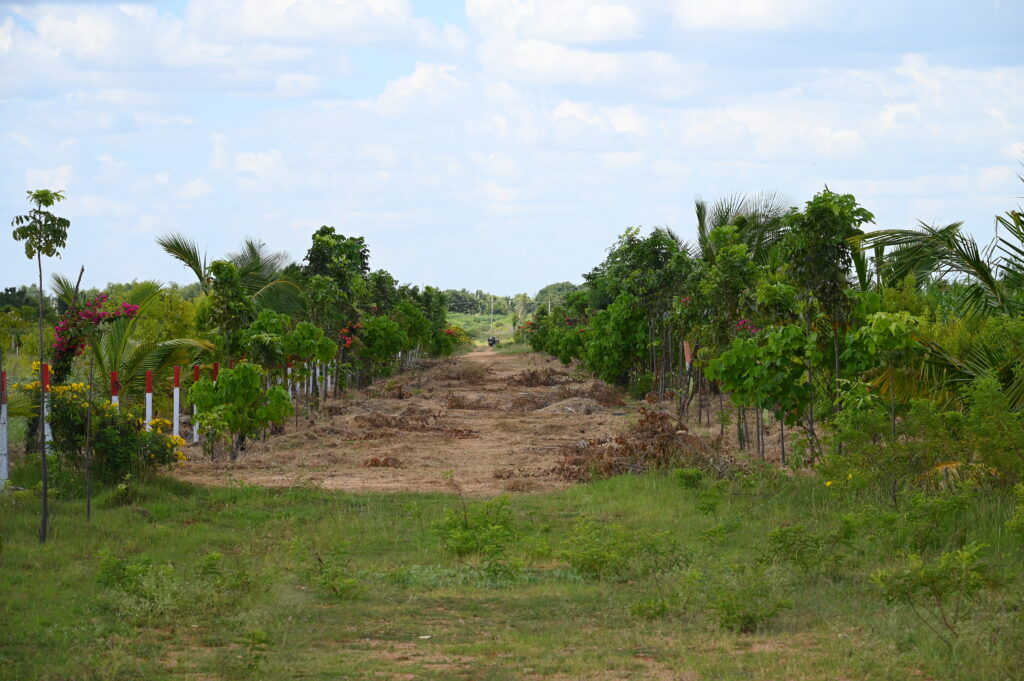

The number one question new purchasers ask themselves is a straightforward one: How many acres do I have to buy to make a profit on the managed land? The truth is that acreage is one of the least reliable measures of profitability — there are a lot of other factors such as crop selection, water access, management quality, fee structure and land appreciation that are more important. It explains the concept of returns and what a typical size is in practice, and gives you some tips on how to be sure you’ll get a good profit from the purchase before you make it.
Note: This guide offers general information to consider when making the decision. This is not financial advice; please seek and obtain the advice of a qualified financial advisor and verify facts from projects before investing.
Acreage Is Not the Only Factor Determining Profitability Managed Farmland Near Bangalore
Where it exists, the income of managed land is typically generated from plantation crops, such as mango, sapota, coconut, teak, sandalwood or other tree crops. These crops:
- Grows slowly and only begins to bear fruit after several years.
- Make moderate income per acre even when fully grown.
- Sensitive to weather, disease and market price fluctuations which can affect the “profitability” from year to year.
It’s for this reason that a small area of a high-value crop that has adequate water management can be more productive than a larger area of a low value crop that has inadequate water access. Size is just one of many factors that go into a much greater equation.
Typical Size Ranges for Buyers Pursuing Different Goals
Less than 1 Acre (Typically Sold as Less Than 1 Acre Parcels)
- Farmers were not the primary focus of those that purchased this property, of course, most of the time they were just a pastime activity.
- Generally difficult to make a profit at this level of production due to the significant revenue spent on managing and sharing overheads, such as management fees, most or all of the produce revenue is absorbed into these costs.
- Categorized as a lifestyle item vs farm income, best evaluated for land appreciation potential, not farm income.
1–3 Acres
- The most popular size range of the “managed farmland investment” products being marketed.
- May be able to provide some additional income after the trees are set to fruit in 4 to 7 years, depending on the fruit species.
- Annual farm income may not be the most important consideration for break-even economics; land value appreciation may also be a factor.
- This range is a balance between how much it costs and if it is large enough for management fees to be somewhat proportionate.
3–5+ Acres
- Fixed expenses (security, irrigation systems, labor co-ordination) are distributed over a more productive area and hence the economics per acre is enhanced.
- Farm income is more likely to have a chance of achieving profitability but is generally less than the profitability potential of other asset classes.
- Requires a higher initial capital investment, affecting the risk profile of the investment.
Beyond 5 Acres
- Begins to look like a lifestyle investment that turns into a real commercial farm.
- May require more advanced crop diversification and yield optimization but requires increased attention to the management arrangement.
- Generally only appropriate for a buyer who has a specific agricultural investment goal and not a casual buyer who is just looking for their first home.
Factors That Are More Important Than Acreage Managed Farmland Near Bangalore
1. Crop Selection
Additional crops, like some fruits, sandalwood or teak, may yield better values per acre than other crops being planted, but usually require longer payback periods and/or greater risk and/or more specialized management. Know what you are growing (or proposing to grow) on your plot before you assume it is profitable.
2. Water Reliability
It is possible to produce more from a smaller plot with good and consistent borewell yield or irrigation access, than from a larger plot with poor irrigation access. Before assessing acreage based projections, request actual water yield data and knowledge of the groundwater conditions of the area.
3. Management Fee Structure
If the management company collects a flat annual fee, or a percentage of produce revenue, the numbers are drastically different. A high fixed charge on a small parcel’s relatively low production can completely wipe out the parcel’s net returns regardless of the crop’s productivity.
4. Land Appreciation
The overall “profitability” for most buyers is more closely related to the value of the land itself, rather than the income generated from the farms in one year. It depends more on the developments going on in the area around Bangalore and not on the dimensions of any single plot.
5. Holding Period
Tree crops take multiple years to produce a crop. Any buyer who expects to receive income in the near future, no matter how much land he buys, is generally disappointed. Profitability should be calculated, rather than annually, over a 5–10+ year period.
A Practical Way of Assessing Profitability Managed Farmland Near Bangalore
Instead of trying to specify a target acreage, go through this process for every project you are interested in:
- Don’t accept projections of marketing, rather ask for actual yield and income data from well established plots in the same project.
- Match the management fee with realistic income — work out the percentage of income that the management fee would take at your plot size if you had realistic income.
- Break farm income from appreciation — work out two scenarios; one where you don’t get much farm income (a realistic base case) and one that includes land appreciation (so you know which is really generating farm income).
- Discuss with current owners at the size they are interested in — their first-hand experiences are much more credible than projections in brochures.
- Consider alternative investments — when looking at an investment with low resale liquidity and a long holding period, consider other investments you could have made instead.
Bottom Line on Managed Farmland Near Bangalore
The number of acres needed to make managed land profitable is not a fixed number for all areas around Bangalore. Most buyers are to expect:
- 1–2 acres: Mostly a personal choice; somewhat realistic farm income.
- 1–3 acres: Small return on top of base value, possible appreciation should be a significant portion of the return.
- 3–5+ acres: The improved per-acre economics are offset by being a long-horizon holding with a modest yield, not a high return investment.
- 5+ acres: Becomes a real farm, ideal for those who have a certain intention to farm or invest in the land.
No matter how large or small the farm, ignore the potential for high profits and consider it a “slow and steady income” farm, and never assume that a profitability claim is true based on general assumptions about farm size, but rather on actual historical data from the specific project.