
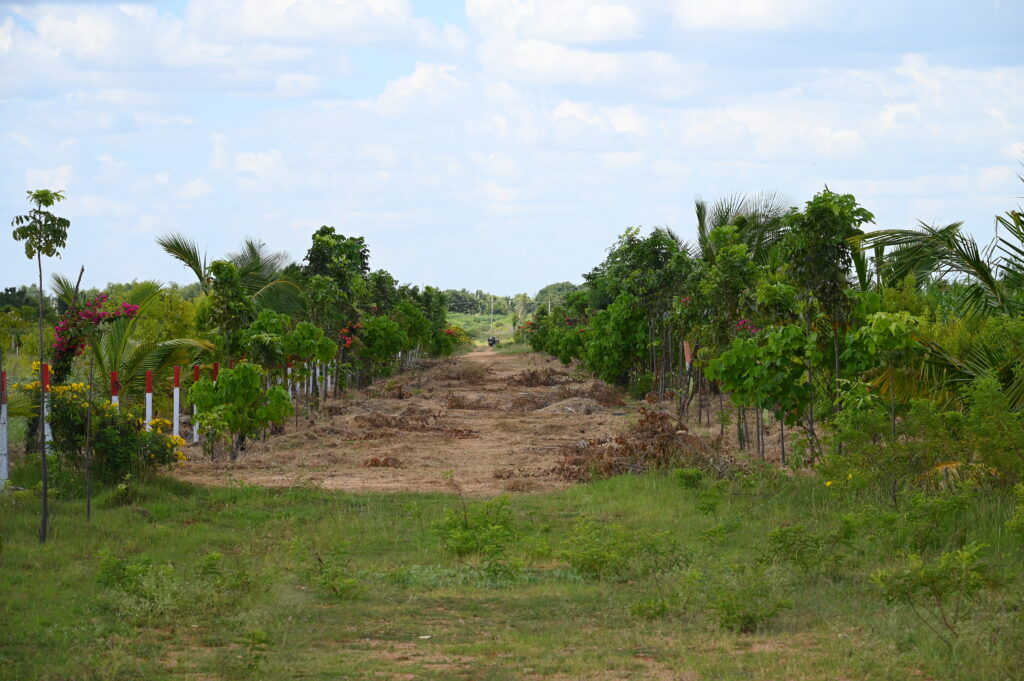

Both give you control of agricultural land close to Bangalore, but the “real world” of operation and the risks, costs and effort are quite different. This guide will help you understand why it is important to differentiate between managed farmland and regular (raw) farmland, and can help you determine the right option for your objectives, resources and interest level.
Note: This guide is general information to help you compare the two models. This is not a legal or financial recommendation — please seek the advice of a property lawyer and financial advisor when buying either property type.
The Core Difference Explained in One Sentence
Regular farmland is land that you own and use or rent yourself, on which you farm or leave it to fallow. Managed farmland: Farmland that is sold as part of a developer-run project, and is managed professionally; typically, but not necessarily, for a fee.
Side-by-Side Comparison
|
Factor |
Regular Farmland |
Managed Farmland |
|
Who manages it |
You or you hire labor directly |
Professional management company |
|
Initial investment |
May be lower per acre |
May be higher (with infrastructure services set-up) |
|
Ongoing cost |
Variable, depends on your own arrangements |
Fixed or revenue-shared management fee |
|
Effort required |
High — you coordinate all of it |
Low — you mostly stay out of it |
|
Infrastructure |
Usually none, and you create your own |
Often includes irrigation, boundary walls and shared amenities |
|
Farming skills required |
Yes — must acquire them or hire them |
No — they are already in-house |
|
Legal complexity |
Standard land due diligence review |
Standard land due diligence review + management contract review |
|
Produce ownership |
Fully yours |
Owned, shared and/or fee-offsetting |
|
Community/amenities |
Typically none |
Often involves shared facilities, security and common areas |
|
Liquidity |
Depends on location and buyer pool |
Often similar or slightly lower, due to added complexity in contracts |
|
Personalization |
Full control over what’s planted and how |
Limited to what the management plan/project will allow |
What is Regular Farmland?
When you purchase a regular agricultural land near Bangalore, you are accountable for every thing outside of the legal purchase:
- Farming decisions – what to grow, when and how (this may include your own skills and/or employment of agricultural workers).
- Water infrastructure – digging or accessing borewells, setting up own irrigation, and managing own water rights.
- Security and maintenance – making sure the land is not overrun, used illegally or maintained poorly, particularly when it is not visited regularly.
- Actively selling produce — self-marketing or self-finding a market or buyer for all crops (actively selling).
- You are responsible for planning and funding all infrastructure costs – roads, fencing, structures and utilities.
Benefits of Regular Farmland
- Lower purchase price per acre – no management infrastructure or services paid for.
- Absolute authority over what can be grown and how the land is utilized.
- No continuous management expenses.
- More straightforward legalization (no need to sign a separate management contract).
Cons of Regular Farmland
- Needs knowledge of farming or coordination of hired labour.
- No infrastructure at all — you are responsible for everything when it comes to setup.
- More time and dedication – particularly if not in close proximity to you.
- Land can be left without care, or be taken over without permission.
- No community, security or amenities shared.
Managed Farmland – What It Really Means
Managed farmland transfers the responsibilities of running the farm to a professional farm management company, and usually results in higher sales prices and fees:
- Turnkey cultivation — the management company plants, manages and sometimes harvests the crops based on a contract.
- Shared infrastructure — includes irrigation systems, boundary security and shared amenities are usually a part of the project.
- Structured agreements — a formal management contract provides fee, services, produce handling.
- Community element — a number of managed farmland projects are created in groups of comparable purchasers, possibly sharing facilities such as clubhouses or farm houses.
Pros of Managed Farmland
- Hands-off ownership (no farming skills or experience needed).
- Existing professional infrastructure is in place.
- Usually provides security and maintenance monitoring, which minimizes encroachment risk.
- A more resort atmosphere for personal visits with amenities for the community.
- A well-documented and structured management relationship (which may vary in quality, depending on the developer in practice).
Cons of Managed Farmland
- Lack of control on farmland.
- A greater initial investment per acre, frequently a considerable amount.
- Monthly dues irrespective of harvest yield or frequency of visits.
- Decreased personal control over what is planted and/or how land is used.
- The outcomes are largely dependent on the management company’s qualifications and duration in business.
- Another layer of legal complexity, besides normal land due diligence, to review a management contract.
Which One Would Make Sense for You?
Regular Farmland Fits Better If:
- You have a true interest and knowledge of farming or a reliable labour force locally.
- You live adjacent to the land or visit and supervise the land on a frequent basis.
- You want to have the greatest control over land use and crop choice.
- You’re looking to save the money versus convenience.
Managed Farmland Fits Better If:
- You would prefer to not be farmers and have land ownership.
- You’re mainly looking for a place to get away to and some passive income.
- You appreciate having infrastructure, security, and amenities that are ready.
- You’re okay with a recurring payment and relationship with a management company.
Due Diligence Differs Too
They both need to do what is known as basic land due diligence, which includes title checks, checking for encumbrance, ensuring buyers are eligible, and water assessment. However, there’s another twist to managed farmland:
- Regular farmland due diligence is almost exclusively on the land, title, water, soil, access, and zoning.
- In addition to the above, careful due diligence of the management company is required, including an examination of the management company’s demeanor, fee structure, produce handling conditions and exit/termination conditions in the management contract — your experience will depend on the management company as much as on the land.
A Practical Middle Ground
Some buyers prefer to buy traditional farm land and engage independent local labour and/or a smaller local farm management service on an informal or semi-formal basis — enjoying some of the convenience of managed farm land without the fully comprehensive bundle of fees paid to a large developer. This can be good for those who know the area, or have someone they know there who can help them, as it doesn’t have the contracts and infrastructure of a managed farmland project.
Conclusion
The actual difference between a managed farm and normal farm, close to Bangalore is in whom it is done by and who is at risk of the operation. Regular farmland provides less cost and complete control and requires real effort, expertise, or oversight. Managed farmland offers convenience, extra facilities and professional supervision, but at a higher price and with less personal input. However, if the management company is to be believed, it has the potential to deliver all of those benefits. There is nothing right or wrong about either of these alternatives, it depends on the amount of hands on involvement you want, the convenience you are willing to pay for and the amount of control you want over the use of the land.