
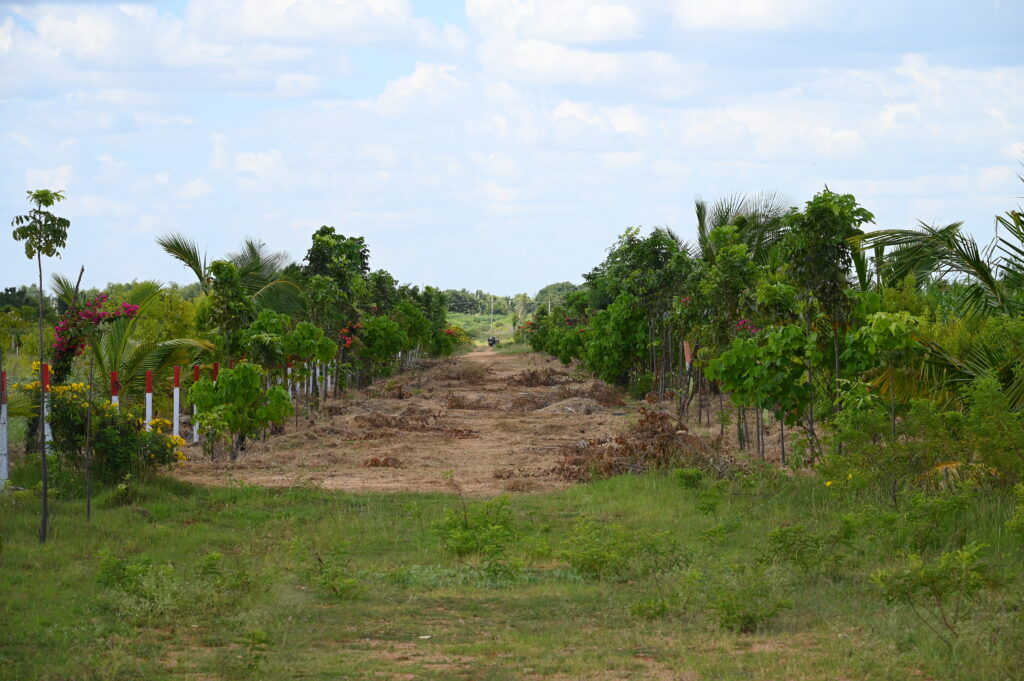

A dialogue is underway in Bangalore at present that the majority of people are not involved in yet. It does not occur during a pitch night of a start up or a tech conference. It occurs silently, during a Sunday drive down the Kanakapara Road when someone refers to a managed farm plot and what it cost three years ago and then what it is worth today.
Invested in lucrative farmland in Bangalore is no longer a niche concept to rural landowners or affluent agriculturalists. It is now becoming a documented, data based category of investment that is being taken seriously by urban professionals, NRIs, and first-generation investors and with very good reason.
This guide is a one-stop guide to the entire picture: the actual numbers of returns, the market drivers, the best corridors, the tax advantages and the risks that no slick brochure will put you in the picture.
Why Farmland Is Beating up many of the traditional investments in Bangalore
It is worthwhile to have an overview of why the asset category of farmland has been receiving serious consideration both around the world and across India.
In other countries such as the US and Australia, the agricultural land has steadily provided stable returns of between 8 to 12 percent per year. Farmland performs even better in uncertain economic times, as people still have to eat regardless of what the market is doing.
India is no exception to this trend and even more. Indian agricultural market is also expected to increase at a CAGR of 4.90 percent to reach USD 372.94 billion in 2024 and USD 473.72 billion in 2029. The rate of appreciation in land in cities such as Bangalore, Hyderabad and Maharashtra is ranging between 6 to 15 percent per year due to urban growth and development of infrastructures.
Farmland is not only a place of farmers. It is also drawing entrepreneurs, high-net-worth individuals and first-time investors seeking wealth creation over a long term. Industry estimates show that sales of agricultural land will increase by 8-10 percent CAGR in the past five years.
Bangalore is the very centre of the movement. The growth of the city, its climate, its IT-based wealth base and its fertile surrounding areas have created one of the most attractive farmland investment markets in India – and it is not yet too late to jump into it provided you move with sufficient information behind you.
The Numbers: What Actual Returns look Like Near Bangalore
Any claim of returns in any investment area should be questioned. This is what the recorded data of the Bangalore corridor, in particular, reports.
The Knight Frank report of 2024 has indicated that the prices of agricultural land in peri-urban areas such as Hosur, Thalli, and the outskirts of Bangalore has increased by 10-14 percent CAGR. In particular, land prices in Hosur and Thalli increased by 25 percent between 2022 and 2024.
The standard assumptions made in a base-case financial model of farm plots in well-connected corridors around Bangalore are generally that acquisition will be done at 30 to 50 lakh per acre in well-connected corridors. Maintenance and management charges per acre are ranging between 25,000 and 40,000, which cover irrigation, labour and periodic cultivation. Total returns of 17 to 20 percent a year on a blended basis are possible with conservative appreciation of 10 to 12 percent and moderate yield income on crops or leasebacks.
In the vicinity of Bangalore, most of the managed farmland investments have yielded between 8 and 23 percent annually combining land appreciation, crop yields, and demand-side growth. Investors have taken a great interest in land values near Bangalore, which has experienced a 10 to 25 percent increase in land values every year, making it very attractive as an investment destination.
That 8 to 23 percent is an actual and deliberate arithmetic. The returns vary depending on where you are located, the quality of the soil, water availability, type of crops and most importantly, day to day management of your land. The dispersion is present due to the fact that farmland is not a passive index fund. It compensates the knowledgeable customers who make the correct choice of plot in the correct corridor with the correct professional team behind them.
Investment Locations: The most profitable farmlands along with the city of Bangalore
The most crucial variable in a lucrative investment in farmland is location. The following is the comparison of the major corridors by 2026.
Devanahalli and Hoskote are the heads of the appreciation story in North Bangalore. Devanahalli and Hoskote are also suitable to fruit orchard and multi-crop yield farmlands with optimal connectivity, fertile soil, and urban vicinity that provide both farmland agricultural earnings and high value appreciation potential. The fact that it is close to the Kempegowda International Airport and expanding aerospace and tech industries makes this zone a long-term appreciation play on top of the farming returns.
Kanakapara Road has been attracting buyers who desire a blend of investment and lifestyle. Kanakapara Road is a serene, tourist friendly belt with natural topography – popular with plantations, fruit orchard, and eco-farm opportunities where access to water and green landscapes provide a stable environment to undertake sustainable activities.
Thalli and Denkanikottai, which are straddling the Karnataka-Tamil Nadu border have established a reputation to be the most performance-oriented places in the entire Bangalore farmland market. The top investor list is topped by Thalli and Denkanikottai based on red soil, good access of water and proximity to Bangalore. Naturally, higher-value crops are more appropriately grown in these areas and yields are very variable, depending on the quality of management team and quality control measures.
Nelamangala and Doddaballapur target buyers who are interested in agro forestry and larger tracts of land at lower and more accessible entry points. They are fast emerging corridors of high-tech agro forestry, eco-farming and agri-startup potential are also emerging across Magadi and Bidadi as well.
The common sense law of every road is identical. The optimal range of investment between Bangalore is 50 to 90 km. The range that is even more distant would imply lower appreciation and more difficult resale. Closeness to highways or ring roads spurs quicker appreciation despite the direction that you take.
How this Investment becomes accessible with the help of how Managed Farmland Works
A decade ago, when you purchased farmland near Bangalore you also had to know how to run a farm. The majority of city customers lacked time and experience. That equation was revolutionized by the managed farmland model.
Managed farmland is agricultural acreages that are in full ownership by individuals but under the professional care of expert farm management teams. These teams do all the work, including land preparation, irrigation and crop growing as well as harvesting and even renting farm stays and you as the owner can sit back and enjoy passive returns and periodic updates. It is similar to making a purchase of an income-generating asset that runs in the background as you concentrate on your primary career or business.
The development of farmland investment around Bangalore is closely connected with macroeconomic and spatial processes which determine the development of the city. The metropolitan area has grown very fast in the past 10 years along the radial lines, transforming huge agricultural land blocks into mixed-use areas. This trend has led to a lack of fertile, legally clear farmland in an accessible distance of the city, and as such, prices in the peripheral areas have steadily appreciated in value.
The most prosperous investors in 2026 create farmland portfolios that combine not only the short-term yield but also the long-term appreciation. Farm plots around Bangalore are now acting like balanced, inflation-hedged portfolios based on both nature and financial prudence.
Carbon credits are one of the more recent sources of income, which are starting to be taken into consideration by forward-looking investors. Carbon credits can be generated by sustainable and organic farming operations on your land and traded on verified markets a true third stream of returns that many buyers have yet to incorporate into their projections.
The Tax Benefit that Makes Farmland the Only Asset Class to Be Taxed
This is the monetary payoff that the majority of Bangalore investors do not truly appreciate until they are comparing post-tax returns on their portfolio.
Section 10(1) of the Income Tax Act provides agricultural income in India to be tax-exempt. In the investment, lower stamp duty in agricultural areas in some states contributes to the overall cost effectiveness of the investment.
The difference between earning additional income legally tax free through a well structured farmland investment and the present income which is legally taxed at 30 percent income tax on salary plus short term capital gains tax on equity is a significant financial benefit. It is not one of the loopholes. It is a strategically planned incentive in the Indian tax law which aims at promoting investment in agriculture.
Under some conditions, agricultural incomes in India are not subject to income tax, and therefore, are an excellent instrument to use in tax planning. This is based on the nature of how the income is generated and whether or not the land is considered as agricultural under the local laws.
The caveat in this case is important. The income received through farmhouse rentals, agro-tourism activities, or weekend stay operations is not considered to be agricultural income, but rather a source of income in the form of house property, or business income and is taxed as such. The exemption under Section 10(1) only applies to documented crop income of qualifying agricultural operations. When one gets the investment right the tax advantage is very real and substantial.
Active Support by Government that is actively generating returns
Investment in profitable farmland around Bangalore is not in a policy vacuum. The government, the central and state, is currently making the environment in which the farmlands profitability is enhanced.
Such government measures as Pradhan Mantri Krishi Sinchai Yojana (PMKSY) and DILRMP are improving irrigation systems and land record management, increasing farming productivity, and providing the agricultural sector with a long-term stable situation. Increasing environmental awareness, and the growing demand among consumers have brought about an opportunity to invest in higher returns associated with eco-friendly farming practices.
The shift towards institutional capital in the sector and the consequential growth of land values has been brought about by the focus by India on AgriTech, organic farming and rural infrastructure.
With forecasts of continued growth in urban and export markets, demand on traceable, residue-free produce continues to grow in urban and export markets, further driving increase in land and crop values around Bangalore. Managed farmland projects that incorporate AI, satellite imagery, and IoT-based monitoring can boost yields by up to 30 percent compared to unmanaged counterparts, according to Farmonaut’s 2025 analysis.
This layer of technology is transforming what in practice farmland returns would look like when utilized in practice. When professional operators apply precision irrigation, data-driven harvest control and drone-based crop surveillance, the difference between a well-managed and a poorly-managed farm plot extends dramatically. The option to go with a provider that has the real AgriTech capability is no longer a choice, but a choice that is return determining.
The Risks Honest Investors Must Know
There is no guide that you can trust and he will omit the dangers. The fact that in Bangalore profitable investment in farmlands exists has not been unfrictionless.
Managed farmland has a gestation period – particularly in the case of fruit trees or timber. The period of time might be 2-4 years before you can see significant cash flows. Farmland India Sometimes murky paperwork can accompany farmland. Otherwise, you may find yourself with an inconverted or controversial piece of land. It is always advisable to have clear title verification and legal vetting ideally by the management provider.
Omission of verification of boundary or mere disregard to minor encumbrances may lead to long and protracted disputes. Check all of the documents and make sure that digital survey overlays prove your title. The dynamic regulatory landscape in North Bangalore implies that legal clearance, soil health and water management are not checkboxes, they are the backbone of any agricultural land investment.
There are three categories of risks that are applicable to the Bangalore market, in particular. Land that has been given PTCL protection – land that was initially granted to SC/ST families – cannot be sold without special clearance and can be reclaimed years after purchase when the check is not drawn. When new infrastructure rings are declared, master plan conflicts can freeze or purchase your land. And lock-in clauses in managed farmland contracts may restrict your resale rights over three to five years, or have right-of-first-refusal provisions that limit your selling price below the open market price.
Risk management in investment in the farmland is data-driven and preventive in 2026. The most prosperous investors have made risk reduction a component of their business strategy – tracking, analyzing, and adjusting performances of their lands not as a response to the failures.
An Action-Plan Roadmap to Starting
Should you be persuaded that the opportunity is real and that you would like to proceed here is the step-by-step process that experienced investors go through.
The research providers selectively and select those companies that provide a clear title land and complete management services. Know what you want to achieve, is it a lifestyle, long-term ROI, or both? Go to sample plots, discuss with current investors, and inquire about crop plans. Starting with 0.5 to 1 acre is a good start and go bigger once you are sure. Monitor your returns as in any other investment – be aware and engage.
The most appropriate is a combination of selecting a growth zone close to growing metros or tourist belts to achieve high ROI, adopting managed solutions to reduce risk and maximise income, diversification of crops through intercropping or orchard systems to ensure year-round harvest, water availability through borewells and rainwater collection systems, and looking at add-ons such as farmhouses, agri-tourism setups, and events that can increase the land value.
Obtaining the legal clearances in the correct sequence. Check with RTC and verify the land is registered as agro land. Get an Encumbrance Certificate going back at least 30 years. PTCL search should be conducted to ensure that the land has never been granted as SC/ST. Compare the existing zoning status with the recent master plan. And then only then consider the crop plan, track record and actual investor references of the management company.
The Bottom Line
The purchase of farm land in Bangalore is not merely about planting crops, rather it is about planting wealth, wellness and a future ready asset. Due to increasing demand, rural infrastructure expansion, and newer forms of businesses making the acquisition of farmland a smart addition to a diversified investment portfolio, farmland has become increasingly viewed as a smart addition to a diversified investment portfolio.
Farm plots around Bangalore are going to be a mainstream, high performing category of investment in 2026. Managed farmland models make ownership simpler and improve returns in the long term. Rates of appreciation are between 10 to 15 percent per year with other returns coming in through cultivation or tourism. Legal reforms, and infrastructure growth have reinforced the investment ecosystem significantly.
Profitable farmland investment in Bangalore works. However, it is most effective when used by investors who take it like the serious asset class it is – with due diligence, informed location decisions, a clear understanding of the tax structure, and a management partner whose fees are earned on an annual basis. Get those elements in place and you will probably look back in a decade and wonder why it took you so long to plant something real.